Choosing the right lender is even more important when closing out of state, because you can't step in and deal with a problem in person the way you could at home. There's more room for something to go wrong along the way.
So, we wrote this guide to cover the factors out-of-state investors should consider before partnering with a lender. It can be the difference between closing quickly and without stress, or having closing drag on for months.
We then compare several lenders against those factors so you can see how each stacks up.
Who we are: Constitution Lending is a direct DSCR lender that has originated hundreds of millions of dollars in DSCR financing to out-of-state investors. Enter some details about your deal into our automated pricer to generate instant quotes and see what you qualify for.
Factors to Consider When Choosing a DSCR Lender for Your Out-of-State Deal
How Quickly Do They Send Quotes, Term Sheets, and Loan Offers?
Many lenders can lend out of state, but they are extremely slow in practice. We've heard from borrowers whose lender promised to close in 7 days but ended up taking over 30 days.
This long closing time stems from outdated, bureaucratic processes: back-and-forth emails, a loan officer who takes days to review your file, and phone calls where you re-explain the same deal all over again.
To avoid these problems, we recommend filtering lenders based on how quickly they issue quotes, term sheets, and pre-approval letters, since it reflects their internal efficiency. If a lender takes several days to send an offer, that delay usually reflects an inefficient internal process. Don't expect things to speed up as you get to closing.
The fastest out-of-state lenders usually issue same-day quotes, term sheets, and pre-approval letters. That turnaround signals the lender has the tools and systems in place to close your deal just as fast.
Are They a Broker or a Direct Lender?
Partnering with a mortgage broker can introduce additional uncertainty and stress, including the possibility of a last-minute rejection by the lender.
That's because a broker doesn't fund your loan or make the final decision. They are simply a middleman who forwards your application to a real lender. This creates a problem where if the lender catches something the broker missed, you can be rejected after being told for weeks that everything is fine.
This risk compounds on out-of-state deals, which carry more variables for an underwriter to catch: unfamiliar rental markets, local title or insurance requirements, and property conditions the broker has never seen firsthand.
A direct lender removes that layer entirely. Because they fund their own loans, the people reviewing your application are the same people making the final call. They can tell whether you qualify within hours of receiving your documents, giving you early assurances that the deal will close smoothly.
DSCR Lenders for Out-of-State Investors Compared
1. Constitution Lending: Built to Close Out-of-State Deals Fast
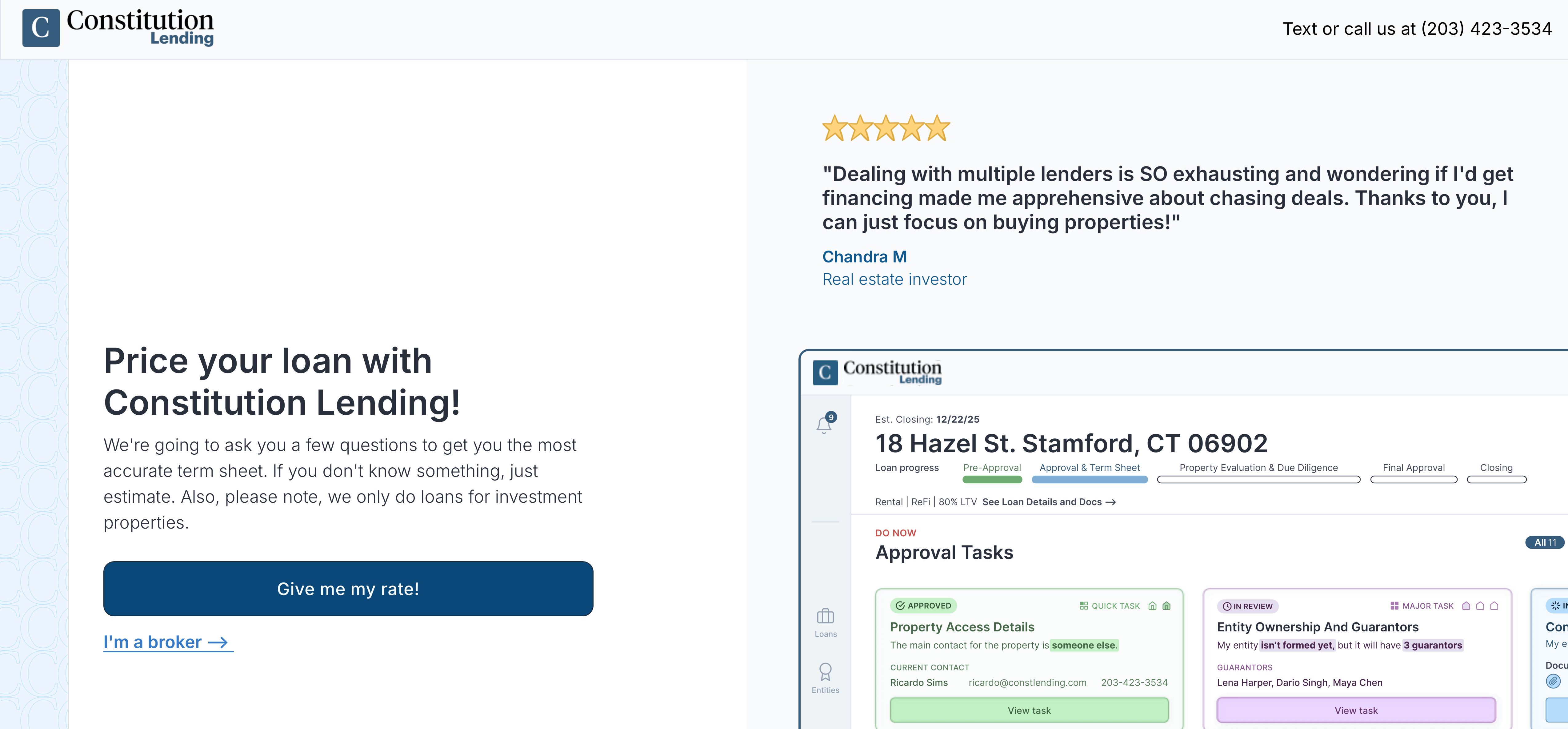
Constitution Lending has funded hundreds of millions of dollars in DSCR loans for real estate investors across the country, including a large share who are financing investment properties outside their home state.
We built our process around those two factors: an automated pricer, documents portal, remote online notarization, and direct lending model that let you close faster and with less stress than other out-of-state lenders.
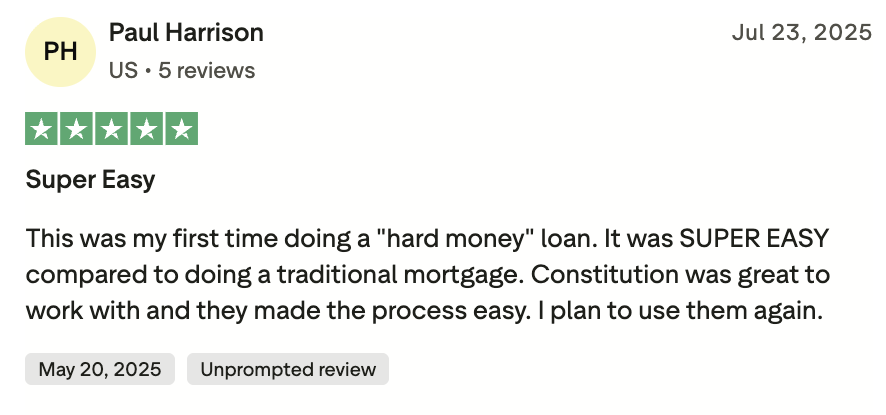
This is what our borrowers say about working with us:


We Close Out-of-State Deals Fast Using Tools Like Our Automated Pricer and Documents Portal
We designed our process around automated tools, so out-of-state investors can close quickly. You don't have to wait days for a loan officer's callback or go back and forth over endless emails the way you would with other lenders.
Here's how the entire process works:
- Enter your deal into our automated pricer. You'll need the property address, property type, purchase price, requested loan amount, and your credit score.
- The pricer immediately returns three quotes to choose from. Each one shows your interest rate, monthly payment, loan term, maximum LTV, prepayment terms, and available buydowns.
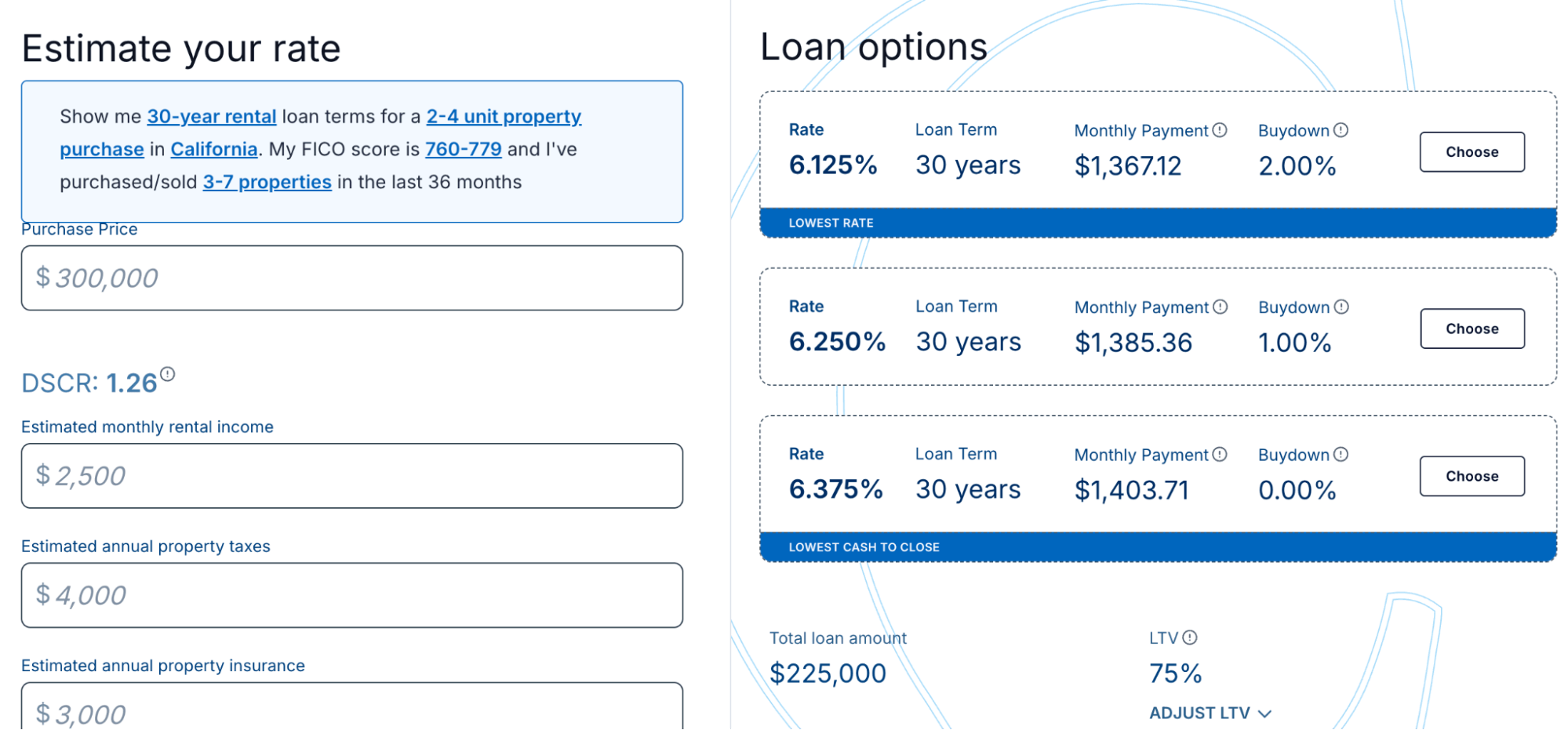
- We suggest running multiple loan scenarios before choosing a quote. Adjust the loan amount, LTV, and after-repair value to see how different variables affect your financing options in real time.
- Select your preferred option and enter your contact details. You can download a term sheet, pre-approval letter, and copy of your quote on the spot.
- You'll receive access to our documents portal, which outlines exactly what paperwork is required. You can upload everything digitally, no printing, scanning, or mailing required.
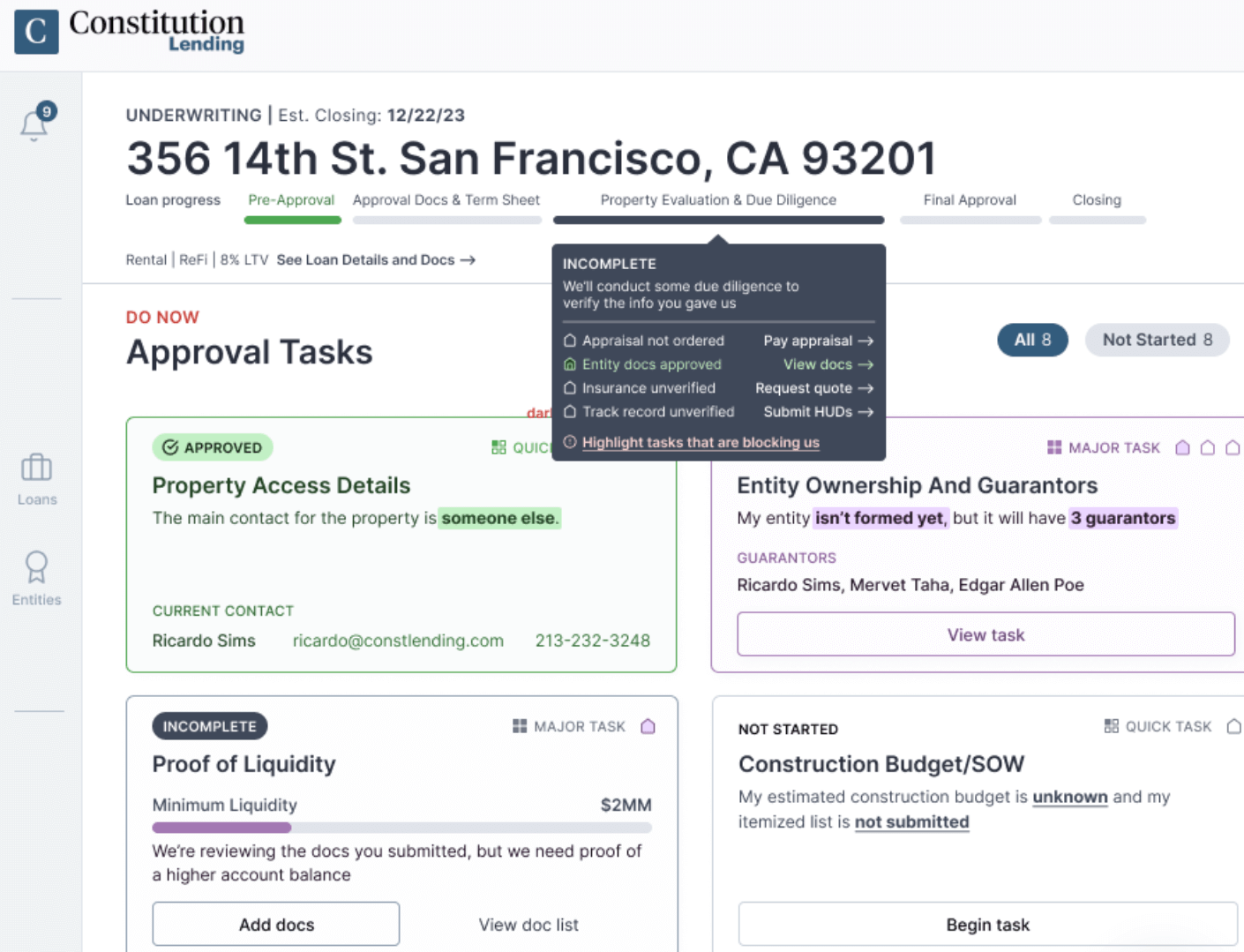
- You can text or call your loan officer through our documents portal whenever you have questions.
- Once you submit your documents, you will receive a definitive answer within a couple of hours.
- We close in 7 to 14 days, regardless of which state your property is in. In extreme situations where a borrower's earnest money deposit is at risk because another lender dropped the ball, we've stepped in and closed within 4 days.
Read more: DSCR Loan Pros and Cons: A Detailed Guide for Investors
We Are a Direct Lender, So You're Never Waiting on a Third Party's Final Word
When you work with Constitution Lending, you're speaking directly with the team funding your loan, not a broker relaying your application to someone else for a final decision.
Our team has underwritten hundreds of millions of dollars in DSCR loans, so they know our requirements in detail and can tell you where you stand immediately after receiving your documents. If there's an issue with your file, we'll tell you early so you can address it, rather than finding out weeks later after being told everything looked fine.
That certainty matters even more on an out-of-state deal, where you can't show up in person to solve a problem. When we approve your loan, that decision is final. There's no third party left to introduce a surprise as you get to closing.
Read more: DSCR Loan Rates: 5 Factors That Impact Interest Rates
Constitution Lending's DSCR Loan Requirements
DSCR loan requirements vary by lender, but here's a look at Constitution's minimum DSCR requirements and other qualification criteria.
We evaluate the property's income rather than your personal income, so there's no personal income verification, pay stubs, or tax returns required to qualify.
- Minimum DSCR: 0.75, meaning the property doesn't need to fully cover its own expenses to qualify. The higher your property's DSCR above 1.0, the more positive cash flow it generates, which can help you secure better terms.
- Loan-to-value (LTV): Up to 80% on purchases, meaning as little as 20% down payment, and up to 75% on cash-out refinances
- Minimum credit score: 660 FICO, though a stronger credit profile can help you secure a better rate
- Eligible investment properties: Single-family rentals, condos, 2 to 4-unit properties, and multifamily properties up to 20 units (DSCR loans can't be used for a primary residence)
- Loan amounts: $150,000 to $3,000,000
- Loan term: 30-year fixed
- Maximum financed properties: No cap, as long as each property meets the minimum DSCR and you have 20% to 25% in equity
- Title vesting: LLCs, S-corps, C-corps, and revocable trusts
- Residency: Available to U.S. citizens and foreign nationals
- Flexible prepayment penalty options available
- No maximum debt-to-income (DTI) ratio or cash reserve requirements
- Short-term rentals such as Airbnb aren’t eligible
We also offer DSCR cash-out refinancing to help investors fund their next purchase as part of a BRRRR strategy (buy, rehab, rent, refinance, repeat).
Secure Fast and Stress-Free DSCR Loans for Your Out-of-State Deal
Plug some details about your out-of-state deal into our automated pricer and see what interest rates and LTVs you qualify for.
2. Griffin Funding

Griffin Funding is a direct, non-bank mortgage lender licensed in 46 states plus Washington, D.C., funding DSCR loans up to $4.5 million in-house. Its direct-lending model and broad licensing footprint mean most out-of-state investors won't run into a state where Griffin simply can't lend.
The tradeoff shows up in speed. Griffin has closed loans in as few as 6 days, but its own reporting shows an average closing time of 34 days over the past year, well outside the 7 to 14 day range an out-of-state investor should be looking for. We couldn't find a public automated pricer or documents portal on their site, which may explain why average closing times run so much longer than their best-case number.
3. RCN Capital

RCN Capital is a well-established name in rental property financing, known for bridging hard money loans into long-term DSCR financing, useful if you're refinancing a rehab project you financed elsewhere. As a direct lender, RCN funds and underwrites its own loans rather than passing your file to someone else.
The limitation is property condition. RCN is strict about the state a property needs to be in before it will fund a DSCR loan, so a property that still needs renovation work typically needs a separate bridge loan first, adding a step (and a second closing) that a lender built to handle both in one process would not require. Like Griffin, we didn't find evidence of an automated pricer or documents portal, which may point to a more manual process for an out-of-state borrower.
4. Lendmire

Lendmire describes itself as a nationwide DSCR loan broker operating in the non-QM loan space, shopping your deal across other lenders rather than funding it directly, and advertises closings in as little as 15 days.
That structure is exactly the broker risk covered earlier in this article. Lendmire isn't the one underwriting or funding your loan, an outside lender is, which means the final decision, and any last-minute issue that surfaces during underwriting, sits with a third party rather than with the company you applied through. For an out-of-state deal, where you already can't be there in person to sort out a problem, adding a broker as a second layer between you and the actual lender compounds the exact risk this guide is meant to help you avoid.
5. Angel Oak Mortgage Solutions
Angel Oak Mortgage Solutions has built one of the more flexible DSCR programs in the market, operating in 46 states and accepting a debt service coverage ratio below 1.0, including a no-ratio option for qualified borrowers. They also offer an automated rental income valuation model that estimates a property's market rent instantly at pre-qualification, avoiding the wait for a traditional appraisal in many cases.
The catch is access. Angel Oak operates exclusively as a wholesale and correspondent lender, meaning you can't apply with them directly. Every loan has to be submitted through a mortgage broker or correspondent company, which means the broker risk covered earlier in this article isn't just a possibility with Angel Oak, it's a requirement of working with them at all. For an out-of-state investor who already can't be there in person to sort out a problem, having a broker as a mandatory middleman adds exactly the kind of last-minute uncertainty this guide is meant to help you avoid.