Apartment building investors have four main financing options to choose from. Each one comes with different trade-offs; namely, how quickly you can close, how strict the loan requirements are, and what interest rate you can get:
- Private lenders: Best for fast closing and accessible qualification requirements. The trade-off is higher interest rates than agency loans and commercial banks.
- Agency loans (Fannie Mae and Freddie Mac): Lowest interest available to apartment building investors. The trade-off is a rigorous and time-consuming approval process that evaluates both the property and your personal financial profile.
- Commercial banks: Best for properties with strong upside but don't fit the strict requirements of agency loans. However, they are still slower and more difficult to qualify for than private money loans.
- Life insurance companies: Best suited to large, low-leverage deals starting from $20 million. This makes them a better fit for larger apartment complexes than smaller ones.
In this article, we explore the advantages and disadvantages of each type of lender in more detail, so you can make a good decision based on what’s more important to you and the tradeoff you’re willing to make.
Who are we? Constitution Lending is a direct lender that has originated hundreds of millions of dollars in apartment building and multifamily loans (e.g., 30-year DSCR loans, fix-and-flip loans, bridge loans, and construction loans). You can use our automated loan pricer to generate instant quotes and see what rates, terms, and amounts you qualify for.
1. Private Money Lenders
Private money lenders are non-bank companies or individuals that approve loans based on the property's value, net operating income, and overall deal quality. Unlike commercial lenders and agency lenders, they don't evaluate your personal finances (e.g., income, net worth, debt-to-income ratio, tax returns, employment history). The deal itself is what matters.
That shift in underwriting focus has two advantages for apartment building investors:
- Easier qualification: Private lenders are the most practical option for investors whose personal finances keep them from qualifying for conventional bank financing. That includes investors with complex income structures, non-W2 income, tax write-offs, a leveraged real estate portfolio, or an upcoming refinance.
- Fast closing: Because private lenders don't extensively review your personal finances as banks do, they can fund significantly faster. At Constitution Lending, for example, we can close in 7 to 14 days, compared to the 45 to 90 days that banks and agency lenders require.
That said, not all private lenders are equal, and the one you choose can determine how many headaches you deal with during closing. Here's how we built Constitution Lending to eliminate drama and complications.
Automated Tools Help Us Close Faster Than Other Private Lenders
As we mentioned above, most private lenders can close significantly faster than banks because their underwriting isn't as strict, but few can actually deliver on a 7- to 14-day closing timeline.
That’s because their internal processes for moving applications forward are inefficient and riddled with bureaucracy. This makes it difficult to compete with the speed of institutional or cash buyers.
For example:
- You submit an application and wait days for a loan officer to call you back.
- Your file then sits in a queue before anyone looks at it.
- Documents are requested in batches rather than all at once, so every missing item adds another round of back-and-forth.
- Appraisals get ordered late because nobody caught the need for one early.
- Title work starts too far into the process. Each delay compounds the next, and a lender that promised two weeks quickly becomes four.
At Constitution Lending, we built our entire origination process around automated tools specifically to eliminate those bottlenecks and deliver straightforward financing solutions. From the moment you enter details about your deal into our pricer, the process moves without relying on a loan officer to push things forward manually.
Here is how it works:
- Enter your deal into our automated loan pricer. Input the property address, loan type, purchase price, requested loan amount, and your credit score. The pricer returns instant quotes showing your interest rate, monthly payment, loan term, maximum LTV, and prepayment terms.
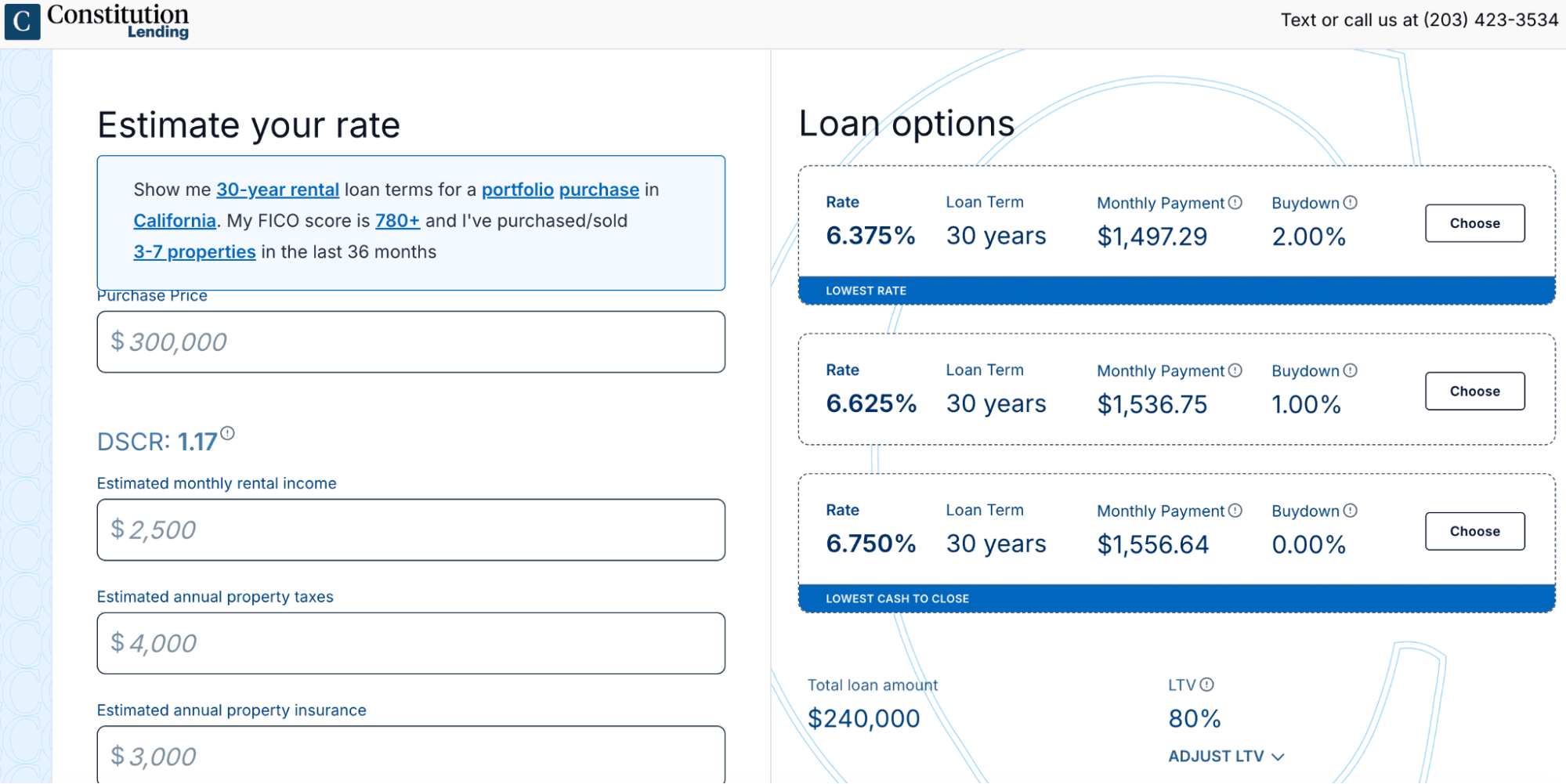
- Download a term sheet and pre-approval letter. Select your preferred quote, enter your contact details, and both documents are available to download on the spot. No waiting for a callback.
- Access our documents portal straight away. The portal lists everything we need for your specific loan type in one place. You can submit everything at once rather than responding to document requests one at a time.

- We review your application and give you a clear yes or no within hours. If something is going to be a problem, we tell you immediately so you can address it early rather than finding out at the last minute.
- We schedule the appraisal and coordinate with the title company to close in 7 to 14 days. In situations where timing is critical, we have closed in as few as four days.
No Last-Minute Rejections, Drama, or Surprises
One of the biggest problems apartment building investors face is last-minute rejections and complications. Many lenders will say early in the application process that you can qualify, just to reject your application shortly before closing.
The main reason why last-minute complications are so common is that brokers don't actually lend their own capital. Instead, they submit your application to a third-party lender who makes the actual decisions.
That creates a problem where the broker can tell you your deal looks good based on their own read, but they have no authority over the final outcome. The real lender does. If the lender catches issues the broker missed, which is very common in complex apartment building deals, they can reject your application after the broker gives you a green light.
At Constitution Lending, we're a direct lender. We lend our own capital on every loan we originate, which means we are the only decision maker on your application. There’s no third-party lender waiting in the background whose criteria you also need to satisfy.
This means we can give you a clear answer early. Once you submit your documents, we review your file and tell you within hours whether you qualify. If something is going to be an issue, you know about it immediately while there’s still time to address it or walk away cleanly. We don't tell you everything looks fine and then surface a problem the night before closing.
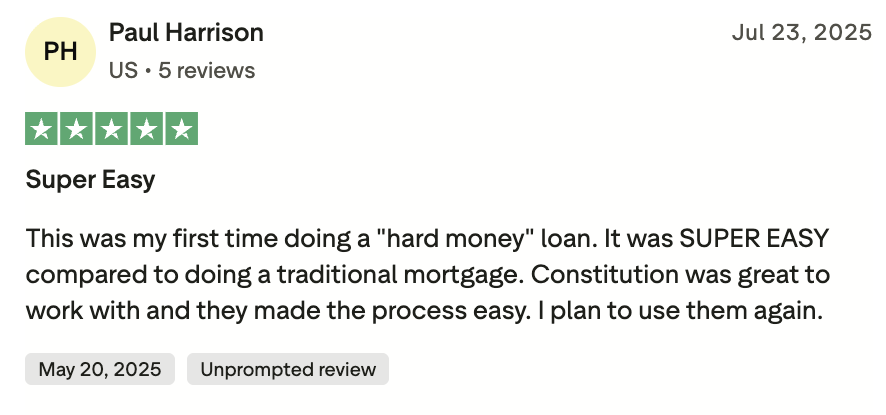
Here’s what apartment building investors say about working with us:


Close on Apartment Buildings in 7 to 14 Days with Constitution Lending
Enter a few details about your deal into our pricer and generate instant quotes, term sheets, and pre-approval letters, with closing available in as little as 7 to 14 days.
2. Agency Loans (Fannie Mae and Freddie Mac)
Agency loans are multifamily loans backed by Fannie Mae or Freddie Mac, two government-sponsored enterprises that buy mortgages from lenders to keep capital flowing into the multifamily market.
However, you don't borrow from Fannie Mae or Freddie Mac directly. Instead, you work with an approved lender who originates the loan under agency guidelines, then sells it to the agency after closing.
Requirements
Agency loans have the strictest qualification standards of the four lender types because approval depends on both the property and your personal financial profile.
Lenders will evaluate your credit score, net worth, liquidity, and experience owning or managing multifamily properties. The property itself needs to show stable occupancy and strong historical cash flow, since agency underwriting relies heavily on debt service coverage ratio (DSCR) calculations.
Most agency loans also require a minimum of 5 units, though smaller deals may qualify through Fannie Mae's small loan program, which offers a more streamlined process for properties that don't need larger loan amounts.
How to Apply
You'll need to work with a lender approved to originate Fannie Mae or Freddie Mac loans.
The process starts with submitting a full application package: tax returns, personal financial statements, entity documents, rent rolls, and property financials.
From there, the lender orders third-party reports (appraisal, environmental, physical condition assessment) and underwrites the deal against agency guidelines. Expect the full process, from application to closing, to take 45 to 90 days.
Pros
- Lowest interest rates available for apartment building financing
- Long-term fixed rate options, often with 30-year amortization schedules that keep monthly payments manageable
- Non-recourse loans are common, limiting your personal liability
Cons
- Slowest closing timeline of the four lender types
- Requires extensive documentation of your personal finances
- Property must meet strict occupancy and cash flow requirements, which excludes many value-add or transitional deals
- Prepayment penalties are common, which can make refinancing or selling before the loan term ends costly
3. Commercial Banks
Commercial banks are financial institutions that offer apartment building and commercial real estate loans using their own deposits as capital. Unlike CMBS loans, which are pooled and sold to investors as commercial mortgage-backed securities, bank loans stay on the bank's own balance sheet, giving them more flexibility to negotiate terms directly with you.
Commercial banks sit between private lenders and agency loans in terms of speed, rate, and flexibility. It’s better suited to properties with upside that don't fit agency requirements, but still more conservative than private money lenders.
Requirements
Commercial banks evaluate both the property and your personal financial profile, though usually with more flexibility than agency lenders. They'll look at your credit score, income, and overall banking relationship, sometimes offering better terms if you already hold deposits or other accounts with them.
On the property side, banks want to see reasonable cash flow and a clear plan for the asset, even if it isn't fully stabilized yet. Local and regional banks, along with credit unions, tend to have more flexibility than large national banks, especially for apartment complexes with some upside potential.
How to Apply
To qualify for a bank mortgage, you’ll typically start by meeting with a commercial loan officer, often at a bank where you already have an existing relationship. The application requires financial statements, tax returns, a business plan or investment thesis for the property, and a rent roll.
The bank then orders an appraisal and underwrites the deal internally, since banks don't sell these loans to agencies. Closing timelines usually range from 45 to 60 days, faster than agency loans but still slower than private lenders.
Pros
- Lower rates than private lenders
- More flexibility than agency loans for properties with upside or minor stabilization issues
- Opportunity to build a banking relationship that can help with future deals or refinance options
Cons
- Still requires significant documentation of your personal finances
- Slower to close than private lenders
- More conservative underwriting than private lenders, making them a poor fit for distressed or heavily transitional properties
4. Life Insurance Companies
Life insurance companies lend on apartment buildings as a way to invest their policyholder premiums into stable, long-term assets. These loans are typically reserved for large, low-leverage deals, since insurance companies prioritize capital preservation over yield.
Requirements
Life insurance loans are suited to institutional-quality apartment buildings, generally starting at $20 million and up. Leverage tends to be conservative, often capped at 50% to 65% loan-to-value, since insurance companies want a significant equity cushion protecting their capital.
Properties need to be fully stabilized with strong, consistent cash flow. Sponsor experience matters too, since insurance companies prefer borrowers with a track record managing institutional-scale multifamily lending.
How to Apply
Life insurance loans are usually accessed through a mortgage correspondent or broker who has an existing relationship with the insurance company, rather than applying directly.
The process involves submitting detailed property financials, a sponsor track record, and a business plan for the asset. Because these are large, conservative loans, underwriting can take time, often 60 to 90 days from application to closing.
Pros
- Competitive rates, often close to agency and FHA/HUD pricing
- Long loan terms, sometimes up to 30 years
- Reliable capital source that isn't affected by the same market fluctuations as banks
Cons
- Minimum deal size excludes smaller apartment financing needs
- Conservative leverage limits how much capital you can access relative to the property's value
- Slow closing timeline, unsuitable for time-sensitive acquisitions
Frequently Asked Questions
How hard is it to get a loan for an apartment building?
Difficulty depends on which lender you use. Private lenders are the easiest to qualify for, since they approve loans based on the property's value and deal quality rather than your income, credit, or tax returns. Banks and agency lenders are harder, since they evaluate your personal financial profile alongside the property.
How can I finance an apartment building?
You have four main options: private lenders, agency loans, commercial banks, and life insurance companies. Private lenders offer the fastest closing and easiest qualification, though at a higher rate. Agency loans offer the lowest rates but the strictest approval process. Banks sit in between, and life insurance companies are reserved for large, low-leverage deals.
Who qualifies for an apartment building loan?
It depends on the lender type. Banks and agency lenders require a strong personal financial profile, including credit score, net worth, and liquidity. Private lenders qualify you differently: they approve loans based on the property and deal itself, which makes them accessible to investors with complex income, non-W2 income, or a heavily leveraged portfolio who wouldn't otherwise qualify.
What factors do lenders consider when approving apartment building loans?
Two categories: the property and the borrower. On the property side, lenders look at value, cash flow, and occupancy history. On the borrower side, banks and agency lenders review credit score, net worth, liquidity, and multifamily experience. Private lenders skip the borrower review almost entirely and focus on the deal itself.
What are the best lenders for financing an apartment building?
The "best" lender depends on your situation rather than one universal answer. If speed and accessible qualification matter most, a private lender like Constitution Lending fits. If the lowest possible rate matters most and you can handle a slower, document-heavy process, an agency loan fits better.