As the name suggests, BRRRR lenders specialize in financing both stages of the BRRRR method (buy, rehab, rent, refinance, repeat). This includes fix-and-flip loans to buy and renovate distressed properties, as well as long-term investment property loans to refinance them into rentals.
The main advantage of using a single lender for both loans is that the lender already knows your deal, so you don’t start from scratch when you refinance. You’ll only need to provide a few updated documents, such as your leases, security deposit receipts, and proof of completed rehab draws. This reduces the likelihood of refinance failure and maturity delays.
Despite the benefits, many BRRRR lenders have limitations that slow borrowers down or leave their cash stuck in a deal. Closings can take a month or more, and many lenders require 6 to 12 months of ownership before a cash-out refinance.
In this article, we cover what to look for in a BRRRR lender so you can close quickly, refinance sooner, and recover more of your cash, then compare the top lenders against those factors.
Note: We’re Constitution Lending, a private lender that has funded hundreds of millions of dollars in fix-and-flip, hard money, and DSCR loans, closing most deals within two weeks. Plug your deal into our pricer to get instant quotes showing the rates, terms, and loan amounts you qualify for.
Factors to Consider When Choosing a BRRRR Lender
1. How soon can you refinance after the renovation?
Seasoning is the length of time a lender requires you to own a property before it approves a cash-out refinance based on the property’s new appraised value.
For example, say you’re using the BRRRR strategy and purchase a property for $200,000, put $50,000 into renovations, and it appraises at $350,000 once the work is done. If your lender requires six months of seasoning and you refinance after two, it may base the loan on your $250,000 cost instead of the $350,000.
Generally speaking, most private BRRRR lenders have a seasoning period of 6 to 12 months. Conventional loans such as Fannie Mae loans can be even slower, requiring 12+ months of seasoning.
This long seasoning period hurts you in two ways.
- You stay on your short-term financing the entire time. On a $250,000 loan at 11% interest, that’s about $2,300 a month, or roughly $13,750 over six months of waiting.
- Your cash stays tied up in the property, so you can’t put it toward your next deal. Since many short-term loans run only 12 months, a long seasoning period can also push your refinance uncomfortably close to the loan’s maturity date.
We recommend choosing a lender with a short seasoning period, ideally one to three months.
2. What LTV will they refinance at?
Your refinance LTV (loan-to-value) determines how much cash you can pull out of the property, so it’s one of the most important numbers to compare. A lower LTV leaves more of your money tied up in the property, so you’ll have less to put toward your next deal.
We recommend choosing a lender that refinances at a high LTV (75%+) based on the property’s appraised value, letting you pull out more cash.
3. How fast can they close?
Many hard money lenders advertise closings in one to two weeks, but slow internal processes often stretch that to a month or longer. That delay matters at the start of a BRRRR deal, since undervalued properties tend to attract cash buyers who can close in days.
A better way to judge a lender’s closing speed is to note how long it takes to send a quote, term sheet, and pre-approval letter. These are the quickest and easiest documents to produce, so if they take several days, expect the appraisal, underwriting, and closing to drag.
Speed also matters during the rehab. Ask how the lender handles draws because lenders that accept photos or video of completed work can release funds faster than those that schedule an in-person inspection for every draw.
We recommend choosing a lender with automated tools that issue quotes and term sheets instantly and a digital draw process that keeps your contractors working.
4. Do they have real estate investing experience?
Few borrowers think to ask whether their lender’s team has invested in real estate, but it matters, especially with a real estate investment strategy like BRRRR.
Lenders without real estate investing experience often rely on rigid formulas to estimate your property’s after-repair value and future rent, leaving little room for human judgment. That means a deal with clear profit potential, such as a property bought below market value in a neighborhood where home prices are rising, can still be declined because it falls short on a single requirement.
We recommend working with a lender whose team has bought, renovated, and rented properties themselves. They can judge whether your rehab plan and rent projections are realistic, and they’re more likely to approve a deal that makes sense even when it doesn’t fit standard underwriting criteria.
5. Are they a direct lender or a broker?
Many companies that present themselves as hard money lenders are actually mortgage brokers, and brokers are one of the main reasons so many deals in private lending run into last-minute rejections and complications.
That’s because brokers can’t approve your loan on their own. They may tell you early on that you qualify, but they still have to send your file to the funding lender, and if that lender finds an issue late in underwriting, your purchase or refinance can still fall through.
We recommend working with a direct lender (i.e., a lender that funds loans with its own capital). Because the same team that reviews your application also funds it, you’ll know early whether you will close, which reduces the chances of last-minute drama and rejections.
5 Popular BRRRR Lenders Ranked
1. Constitution Lending: Fix-and-Flip and DSCR Loans From One Lender, with Refinancing in as Little as 30 Days
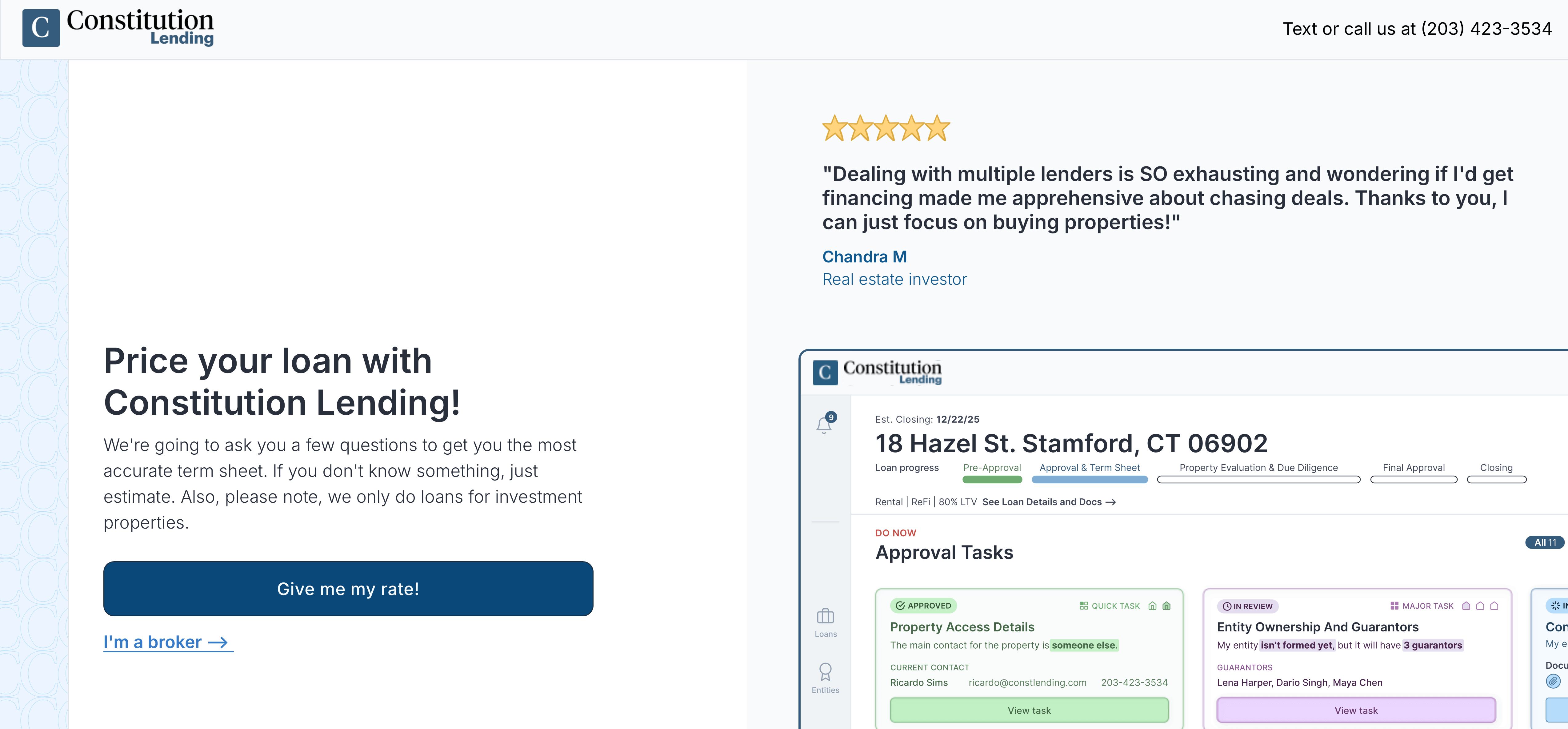
Constitution Lending is a direct lender who provides fix-and-flip loans to buy and renovate properties, and DSCR loans to refinance them into long-term rentals.
Before we started lending, we bought, renovated, and rented properties ourselves and dealt with many slow, unreliable lenders. Purchases took weeks longer than lenders promised, and moving into long-term financing meant waiting out long seasoning periods while our cash sat in properties we’d already finished.
We built Constitution Lending to remove those bottlenecks, so investors can close quickly, refinance soon after the rehab, and move on to the next deal.
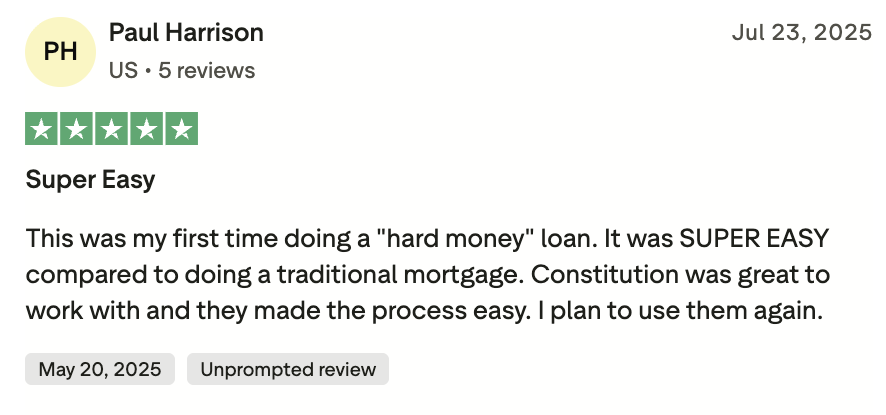
Here’s what borrowers say about working with us:

Below, we cover how we deliver on each of the factors above.
Refinance Into a DSCR Loan After as Little as 30 Days
Our seasoning period is just 30 days, so you can refinance much sooner than the 6 to 12 months many lenders require.
Your refinance is also based on the property’s new appraised value, and since we already know the deal, you’ll only need to send a few updated documents rather than starting a new application.
Pull Out Up to 75% of the Property’s Appraised Value
Our DSCR cash-out refinances go up to 75% of the property’s new appraised value, so you can recover more cash for your next deal.
We also don’t set a minimum debt-service coverage ratio. A property that was only recently leased, or whose rents are still catching up to the market, won’t be blocked from refinancing just because its ratio lands slightly below a typical cutoff.
Read more: DSCR Loan Pros and Cons: A Detailed Guide for Investors
Close in 7 to 14 Days With Same-Day Draws
As we touched on above, a lender’s speed in issuing quotes, term sheets, and pre-approval letters is a good proxy for how quickly it can close.
Our automated pricer generates all three as soon as you enter your deal, and our documents portal lists every document we need so you can submit everything at once.
Here’s how the process works:
- Enter details about the deal into our pricer, including the purchase price, rehab budget, after-repair value, and your credit score, to see three loan options with their rates and terms.
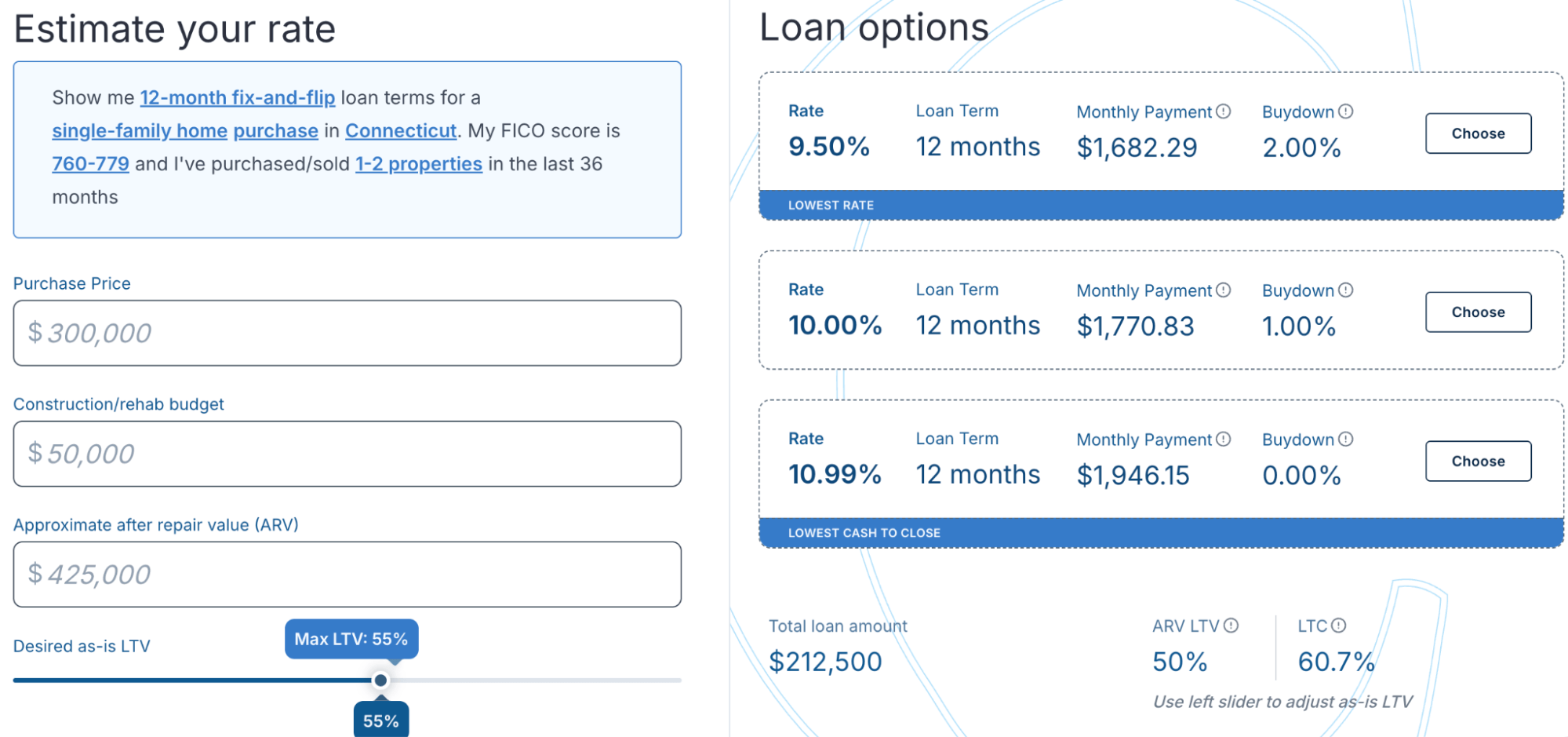
- Choose a quote to receive your term sheet and pre-approval letter right away, along with access to our documents portal.
- Upload your documents through the portal and track your loan’s progress as it moves toward closing.

- Close in 7 to 14 days, or in as little as four days when your documents are ready from the start.
- During the renovation, you can upload photos and video of completed work through the same portal, and we typically release your next draw the same day.
- Once the renovation is finished and the property is rented, refinance into a DSCR loan after as little as 30 days of ownership. Since we already have your file, you’ll just upload your signed leases, security deposit receipts, and proof of completed draws through the portal, and we’ll order the appraisal that sets your new loan amount.
We Were Real Estate Investors; We Review Deals from Your Point of View
Because we’ve bought and renovated properties ourselves, we evaluate your deal the way an investor would. We look at what you’re paying, what the renovation involves, what the property should be worth afterward, and where prices and rents in the area are heading.
That lets us make exceptions for deals that make sense but fall short on one of our requirements, such as a property bought well below market value in a neighborhood where home prices are rising.
We Fund Both Loans with Our Own Capital
As a direct lender, we fund your fix-and-flip loan and your DSCR refinance ourselves, and the same team makes the decision on each. You’ll know early in the process whether both stages will close, with no outside lender stepping in late with new conditions.
Our Loan Requirements
- Loan amounts: $125,000 to $3 million
- Minimum DSCR: None
- Cash reserves: None required for DSCR loans
- Income documentation: No income verification and no tax returns
- Borrowing entity: Individuals or LLCs
- Prepayment terms: Vary by loan, and we’ll walk you through them before you commit
Get Started
If you’re planning your next BRRRR deal, run the numbers through our automated pricer to see the rates, terms, and loan amounts you’d qualify for on both the purchase and the refinance.
2. Lima One Capital

Lima One Capital has financed real estate investors since 2010 and has deployed more than $8 billion across over 30,000 properties. Its Fix2Rent program is built for BRRRR investors, pairing its FixNFlip hard money loans with its long-term rental loan.
Seasoning: Lima One’s rental loans normally require 90 days of seasoning, but that requirement is waived when you refinance from a Lima One fix-and-flip, construction, or bridge loan. That makes Lima One one of the strongest options on this list for refinancing quickly.
Refinance LTV: Cash-out refinances go up to 75% LTV. Fix2Rent borrowers can use one appraisal for both loans and receive up to 50% off the origination fee on the refinance.
Speed: Lima One handles construction draws in-house for Fix2Rent loans, which keeps the renovation stage under one roof.
Direct lender: Lima One funds its own loans, though it also works with mortgage brokers, so applying directly keeps a middleman out of the process.
Requirements: Rental loans range from $75,000 to $2.5 million, with a minimum DSCR of 1.0.
3. Easy Street Capital

Founded in 2016 and based in Austin, Texas, Easy Street Capital describes itself as a leading lender for investors using the BRRRR method. Its EasyFix program covers the purchase and rehab, and its EasyRent program handles the long-term refinance.
Seasoning: EasyRent allows a cash-out refinance of 100% of your costs (purchase price plus rehab) after as little as three months of seasoning. During that early window, though, the loan is capped at your cost basis rather than the new appraised value.
Refinance LTV: Properties owned for three to six months can refinance at up to 70% of ARV, and those owned six months or longer qualify for up to 75%. EasyRent has no minimum DSCR, no income verification, and no tax returns required.
Speed: EasyFix loans can close in under 48 hours, and standard EasyFix loans don’t require an appraisal.
Direct lender: Easy Street lends its own capital and handles both the bridge and DSCR loans in-house.
Requirements: One limitation for newer investors is that EasyFix isn’t available to first-time investors, although EasyRent is. Experience also improves rates and leverage.
4. Kiavi

Kiavi is one of the largest non-bank lenders to residential real estate investors, and Figure Technology Solutions completed its acquisition of the company on September 1, 2026. Kiavi’s BRRRR strategy offering combines its bridge loans with its DSCR rental loans.
Seasoning: Like many DSCR lenders, Kiavi requires seasoning before a cash-out refinance, but its requirement is shorter than most, at 90 days for single-property DSCR rental loans. Free-and-clear properties can take cash out immediately.
Refinance LTV: Kiavi’s examples show cash-out refinances at up to 75% LTV.
Speed: Kiavi’s digital-first platform lets you price your loan online in minutes.
Direct lender: Borrowers can apply with Kiavi directly through its platform. With the Figure integration underway, confirm your refinance terms in writing before you buy.
Requirements: Kiavi’s rental loans cover single-family rentals, 2 to 4-unit properties, PUDs, condos, and manufactured homes.
5. LendingOne

Founded in Boca Raton, Florida, in 2014, LendingOne has funded more than $11 billion in loans for real estate investors. Its Fix to Rent program is its BRRRR loan, combining a short-term rehab loan with a rollover into a 30-year rental loan.
Seasoning: LendingOne’s DSCR loans require three months of seasoning, and its Fix to Rent loans carry a nine-month interest-only term, which gives you time to finish lighter rehabs and refinance in-house.
Refinance LTV: DSCR cash-out refinances go up to 75% LTV, with up to 80% on purchases and rate-and-term refinances. The minimum DSCR is 0.75.
Speed: Fix to Rent loans cover up to 95% of total costs, and borrowers receive discounts when they refinance into a LendingOne rental loan.
Direct lender: LendingOne is a direct private lender that funds its own loans.
Requirements: LendingOne doesn’t set a fixed limit on how many Fix to Rent loans an investor can hold, with approval based on total property count, leverage, and overall exposure.