Los Angeles has one of the most competitive commercial real estate markets in the country.
When an undervalued property hits the market, multiple offers can surface within days, and the buyer who closes fastest often wins. So, your choice of lender can determine whether you close on a property or lose it to a faster buyer.
As a result, most investors look for the following four qualities in commercial real estate lenders: (1) fast closings, (2) simple qualification, (3) competitive rates, and (4) drama-free closings.
Most lenders claim they can do all four of those things well. However, from what we see, that isn’t the case.
Banks and credit unions offer the lowest rates on commercial real estate loans, but they take 60 to 90 days to close and require piles of paperwork. Many private lenders, on the other hand, can close in a fraction of that time, but charge higher interest rates.
In this article, we outline the signs that indicate a lender can close quickly, simplify qualification, offer competitive rates, and manage the transaction without added stress. We then compare five commonly used Los Angeles lenders against those signs.
Enter your deal into our automated pricer to find out what you qualify for and generate instant quotes and term sheets.
Factors to Consider When Choosing a Commercial Real Estate Lender
How Quickly Can They Provide Offers, Term Sheets, and Approval Letters?
Most lenders claim they can close in a week or two, but in practice, that timeline often stretches into months.
So, rather than taking a lender's stated timeline at face value, look at how quickly they respond once you submit your information. Response speed is a reliable signal of how efficient they are behind the scenes, and it tells you what to expect as you move toward closing.
If a lender needs several days just to send a quote and term sheet, that delay usually points to a process bogged down by bureaucracy and multiple layers of internal approval. Don’t expect things to speed up as you get closer to funding.
The fastest lenders utilize automated systems that let them generate quotes, term sheets, and pre-approval letters the same day you submit your information. That kind of turnaround is a strong signal they have the infrastructure to move quickly through the rest of the process too.
What Do They Consider When Evaluating Your Application?
Most big banks and credit unions build their approval process around your personal financial situation. They want to see low debt, high income, W-2s, consistent employment, and clean tax returns before they will consider your deal.
That standard works well for consumer mortgages and first-time real estate investors. But it makes qualifying difficult if you are leveraged across several properties, earn income outside a W-2, or write off a large portion of your income for tax purposes.
Instead, look for a lender that evaluates the property instead of your personal finances. This way, if the deal makes sense, you have a much stronger chance of qualifying, regardless of how your personal financial picture looks on paper.
Are They a Direct Lender or a Loan Broker?
One of the most common problems in commercial real estate financing is borrowers getting rejected at the last minute after being told everything looked fine.
This typically happens when you apply through loan brokers. That's because brokers collect your application and documents, then submit your file to an actual lender for underwriting. Because the broker is not the decision-maker, they can only tell you what they think will happen based on their experience.
If the lender's underwriting team uncovers an issue weeks into the process that the broker didn't anticipate, you can be turned down after being assured for weeks that your loan was on track.
Working with a direct lender removes that layer of uncertainty. A direct lender uses their own capital to fund your loan, which means the person reviewing your application is the same person making the final decision.
They know their underwriting requirements in detail and can tell you whether you qualify within hours of receiving your documents. That allows you to get funding guarantees early in the application process.
Commercial Real Estate Lenders in Los Angeles Compared
1. Constitution Lending: A Direct Lender Built Around These Three Factors
Constitution Lending has funded hundreds of millions of dollars in bridge, fix-and-flip, construction, and DSCR loans for real estate investors across Los Angeles.
We built our process around the same three factors above because they determine whether a deal closes on time.
Here is what our borrowers say about our closing efficiency:


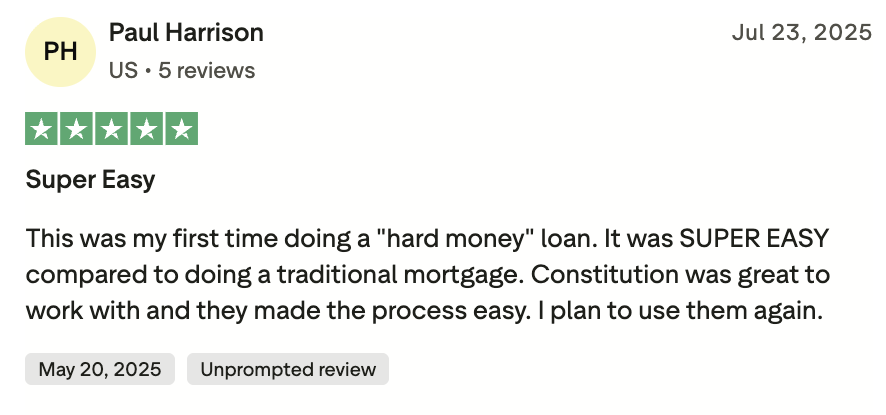
We Close in 7 to 14 Days Using Our Automated Pricer and Documents Portal
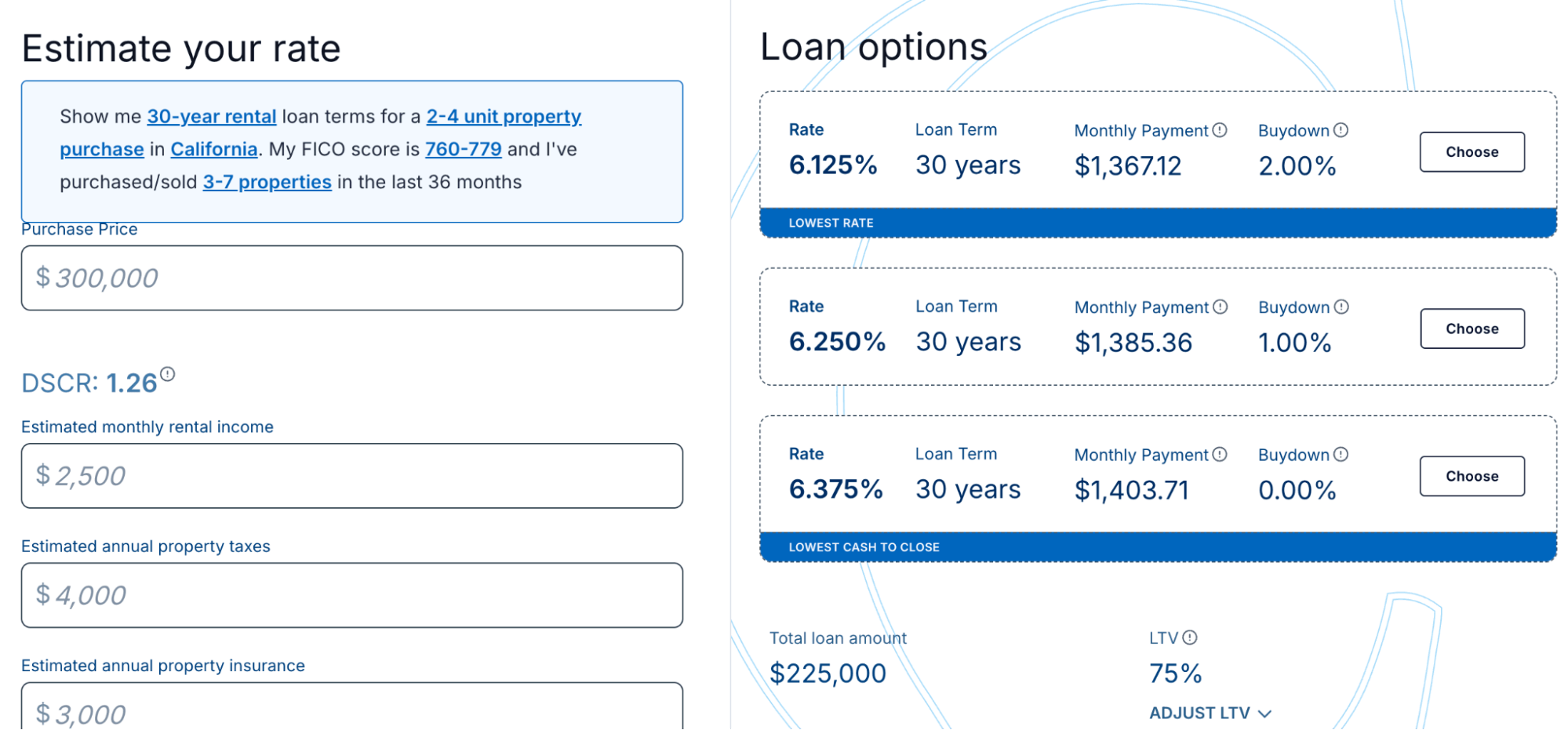
Our automated pricer generates instant quotes, term sheets, and pre-approval letters as soon as you enter your deal, so you know immediately what you qualify for.
From there, our documents portal lays out exactly what paperwork we need from you. You don't have to go back and forth with a loan officer over email, submitting your paperwork in batches.
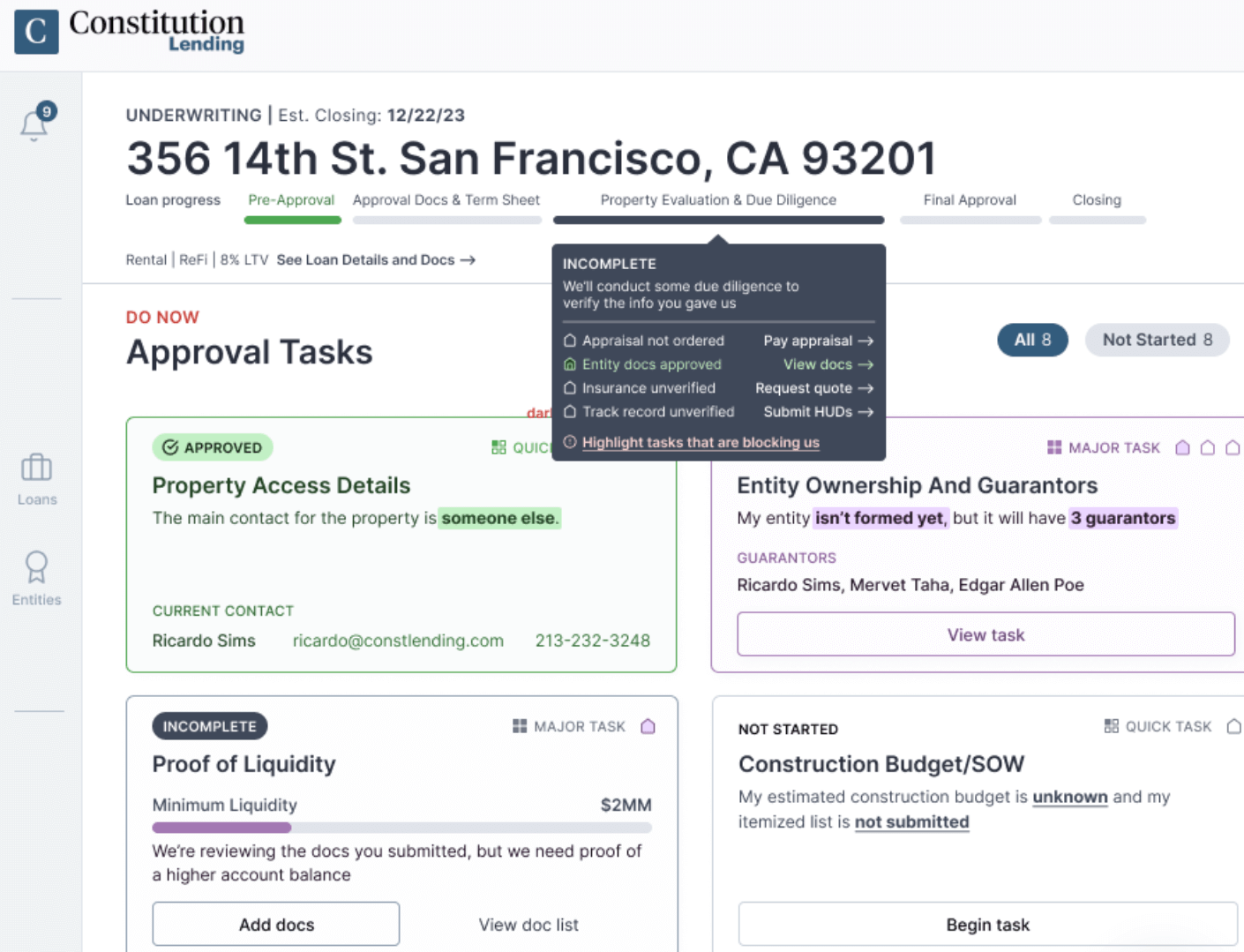
Once you submit your documents, our team reviews them, gives you a concrete yes or no, and sends you offers within a few hours.
Automating these initial steps with our pricer and documents portal lets us close loans in 7 to 14 days. When a deal has been sitting with another lender for weeks and a borrower's earnest money deposit is on the line, we step in and close in under four days.
We Evaluate the Property's Financials, Not Yours
We evaluate your application based on the property's income, expenses, and overall profitability. We don't ask for high personal income, low debt, W-2s, pay stubs, or real estate experience like banks and credit unions do.
For short-term financing like a fix-and-flip or construction loan, we look at the purchase price, renovation budget, and after-repair value. On a long-term DSCR loan, we check the property's rental income relative to the debt service.
You can qualify even if you don't qualify for a bank mortgage because you're leveraged across multiple properties, earn income outside a W-2, or write off a large share of your earnings on your tax returns. None of that counts against you here. As long as the property's numbers make sense, you have a strong chance of qualifying.
Read more: 5 Best Hard Money Lenders in Connecticut + Reviews
We Are a Direct Lender, So You Speak with the People Funding Your Loan
When you work with Constitution Lending, you are speaking directly with the people funding your loan, not a broker submitting your file to someone else for a final decision.
Because we lend our own capital, we know our underwriting requirements in detail and can tell you where you stand within hours of receiving your documents. If there is an issue with your application, we will tell you early so you can address it rather than finding out weeks later.
When we approve your loan, that decision is final, with no third party left to introduce a surprise as you get closer to closing.
That certainty matters most in a market like Los Angeles, where a last-minute rejection can cost you the property and the earnest money deposit you put down to secure it.
Fast and Affordable Commercial Real Estate Loans with Constitution Lending
Use our automated real estate lending pricer to generate quotes and see what amounts, interest rates, and LTVs you qualify for.
2. Chase Commercial Term Lending

Chase Commercial Term Lending, part of JPMorgan Chase, positions itself as the nation's largest multifamily lender, financing apartment buildings with five or more units through loan programs ranging from $500,000 to $25 million or more. It offers both fixed and adjustable-rate term loans with amortization schedules of up to 30 years, and select loans may qualify for non-recourse structuring through its status as a Fannie Mae and Freddie Mac lender.
Beyond apartment buildings, Chase also underwrites commercial property loans for office buildings and industrial assets, covering both purchase and refinance transactions.
The tradeoff is qualification and speed. Chase requires two years of operating history and a current rent roll before it will issue a written quote, and its own materials cite a typical closing timeline of 45 days or less, well outside what a competitive Los Angeles deal usually allows for. Because Chase evaluates the business behind the property in addition to the property itself, an investor without that operating history may not qualify at all, regardless of how strong the deal looks on paper.
3. Banc of California
Banc of California is headquartered in Los Angeles and holds more than $38 billion in assets, giving it more local presence than a national bank like Chase. The bank finances commercial property through construction loans of up to $30 million, with LTVs as high as 75% depending on property type, and its portfolio spans industrial, office, retail space, and self-storage assets.
Alongside its commercial banking division, Banc of California also runs a separate business lending arm that offers working capital lines of credit, so an investor with an operating business behind the property may be able to consolidate more of their banking relationship in one place.
The limitation shows up in the same place it does with most banks. Every product is subject to credit approval, and its construction lending team specifically looks for developers and investors with a track record of completing and operating properties in the markets where they are borrowing. There is no published quote turnaround time or automated system, so getting a firm answer means working with a relationship manager rather than generating one instantly online.
4. Partners Bank of California

Partners Bank of California, based in Mission Viejo, serves small and mid-sized businesses and real estate investors across Southern California. Its real estate lending covers mini-perm loans and construction loans for apartment buildings, shopping centers, and industrial and warehouse facilities, along with SBA loans through both the 504 and 7(a) programs.
The SBA 504 program is the most accessible option in this comparison from a qualification standpoint, since it allows a down payment as low as 10% on owner-occupied commercial real estate, well below what most conventional bank loans require.
The tradeoff is structure and speed. Partners Bank's mini-perm loans typically amortize over 25 years but mature in five to seven years, meaning the remaining balance comes due as a balloon payment rather than paying off in full. And like the other banks in this comparison, every loan is subject to credit approval and customary due diligence, with no published information on how quickly the bank issues quotes or pre-approval letters.
5. Sequoia Commercial Lending

Sequoia Commercial Lending is a Beverly Hills-based commercial loan brokerage, not a direct lender. Founded in 2014, it arranges debt and equity placement ranging from $1 million to $100 million and has financed more than 500 properties since it opened, including bridge loans such as a $24.85 million deal for the retrofit and construction of a mixed-use building in downtown Los Angeles.
Sequoia's usefulness is real. Because it isn't tied to one balance sheet, it can shop a deal across multiple lenders and structure financing that a single bank might not offer. But that same structure is exactly the broker risk covered earlier in this article.
Sequoia collects your application and financials, then places the loan with an outside lender who makes the actual underwriting decision. If that lender's underwriting team flags something weeks into the process, the final call sits with them, not with Sequoia, which is the same last-minute uncertainty a direct lender is built to avoid.