High-yield savings accounts currently pay only 3.8% to 4.2% annual percentage yield, a modest step up from traditional savings accounts, but still leaving many investors searching for yield.
So, we put together this guide covering the six best alternatives to high-yield savings accounts that offer more competitive returns.
However, returns aren’t the only thing that matters. We also evaluated every option on this list against the following criteria:
- Capital protection: Higher returns mean nothing if a market downturn can wipe out your principal. So, we considered how each alternative holds up during market downturns, specifically, whether your principal is structurally protected or fully exposed to losses.
- Liquidity: We also considered how quickly you can withdraw your principal after making your initial investment, since many investors use these accounts to house an emergency fund they may need on short notice. We included investment options with strong liquidity and flagged anything that locks you in for years.
- Minimum investment: A high-yield savings alternative should be accessible and not require a large upfront capital commitment. Lower minimums also allow you to diversify more easily across multiple assets rather than concentrating your principal in a single deposit account.
We start by exploring real estate debt investing, which, from our experience, is the strongest all-round alternative, then cover other options worth considering.
1. Real Estate Debt: Earn Higher Yields with Strong Principal Protection
Real estate debt investing involves lending money to real estate borrowers, or investing fractionally through a lender who does, and earning interest payments in return.
Those interest payments can be significant. For example, investors who fractionally invest in Constitution Lending real estate loans can earn between 10% and 14% annually. (We explain how we generate such returns in more detail below.)
When measured against the criteria above, real estate debt stands out as a strong alternative to a high-yield savings account. Here's why.
Strong Principal Protection During Market Downturns
Real estate debt offers strong principal protection during market downturns because 1) your investment is secured by real estate typically worth more than the loan amount, and 2) when the property is sold, you, as the debt holder, are paid first and in full before the borrower receives anything.
This means the borrower's equity acts as a cushion that absorbs losses in the property's value.
For example, say you invest in a $500,000 loan secured by a property worth $750,000. The borrower has $250,000 in equity. If the property's value falls to $500,000 during a market downturn, the borrower loses their entire $250,000 equity stake, and you recover your full $500,000 principal.
The borrower has to lose their entire equity investment before your principal is affected.
When you invest through a private lender like Constitution Lending, this protection is built into every loan on the platform. We cap loan-to-value at 75%, so every loan on our platform is secured by a property worth at least 25% more than the outstanding balance.
That built-in equity cushion is why our investors have never experienced a principal loss.
You Get Your Entire Principal Investment Back Within 6 to 12 Months
We recommend investing in alternatives that give you access to your capital within a reasonable timeframe. When your money is locked up for years, you lose the ability to respond to changing market conditions, take advantage of new opportunities, or access your funds for personal reasons.
Real estate debt, particularly short-term loans like fix-and-flip and construction loans, offers strong liquidity. They carry terms of 6 to 12 months, with clear maturity dates set at the outset. At the end of the term, the borrower sells or refinances the property and repays the loan in full, returning your entire principal investment.
From there, you can choose to reinvest in more loans to benefit from compound interest, or withdraw for personal reasons.
Constitution Lending's loans run 6 to 12 months, so investors are never more than a year away from full access to their capital. That is meaningfully shorter than most real estate investment options, which lock capital up for 3 to 7 years, and comparable to a 6- to 12-month CD.
Investing Fractionally with a Private Lender Has a Low Minimum Capital Requirement
If you decide to lend money to real estate borrowers yourself, the capital requirement is significant. Originating loans means funding the full loan amount, which typically starts at $200,000 or more depending on the property type and location. That level of capital commitment is out of reach for most individual investors.
Investing fractionally through an established private lender like Constitution Lending removes that barrier entirely. Rather than funding an entire loan yourself, you purchase a fractional share in an existing loan.
For example, Constitution Lending's minimum investment is $1,000, so you don't need hundreds of thousands of dollars to get started. You can also easily diversify across multiple loan types, borrower profiles, and geographies, whether you invest through a taxable brokerage account or a Roth IRA.
Why Choose Constitution Lending for Real Estate Debt Investing
Despite the benefits of investing in real estate debt, the platform you choose matters.
Many platforms carry loans on the verge of default. At Constitution Lending, our investors have never experienced a loss of principal, and here's how we designed our lending model to make that happen.
We Invest Our Capital Alongside Yours, So Our Financial Incentives Align
Most platforms connect loan buyers with sellers and earn their revenue from listing fees and commissions. They do not have their own capital in the loans on their platform, which means they have no financial stake in whether those loans actually perform.
When a platform profits regardless of outcomes, the incentive is to list as many loans as possible rather than to ensure every loan meets a high standard. Unsurprisingly, this tends to result in platforms filled with low-quality loans.
Constitution Lending operates differently because we’re actually a lender. We fund every loan on our platform using our own capital and hold a 50% or greater stake in each loan for the entire term.
That means we are in the same deal alongside you from the day it funds to the day it is repaid. We cannot afford to put a poorly underwritten loan on our platform because our own money is at equal risk.
Read more: 7 Best Alternative Investment Platforms & How to Choose
We Have a Borrower Default Rate of Under 2%
At Constitution Lending, we lend exclusively to experienced real estate professionals, including construction companies, seasoned flippers, and institutional rental investors.
We have spent over a decade building relationships with borrowers of this caliber, and our underwriting standards reflect that.
The result is a default rate of under 2%, so out of every 100 loans we originate, fewer than 2 borrowers default. For context, the national average default rate is 4.26% according to the Mortgage Bankers Association, more than double our rate.
Read more: Investing in Performing Notes: What They Are, Benefits & How to Start
We Offer a Payment Guarantee on Every Loan
Every loan on our platform comes with a payment guarantee.
If a borrower misses a payment, we cover your monthly interest out of our own funds for up to 6 months while we work to resolve the situation, whether that means getting the borrower back on track or liquidating the underlying property to recover your principal and accrued interest.
To our knowledge, no other real estate debt platform offers this level of protection to its investors.
Our Hard Money Loans Have Interest Rates of 10% to 14%
Real estate debt generates significantly higher returns than a high-yield savings account because hard money loans are priced so much higher.
On Constitution Lending loans, for example, borrowers pay between 10% and 14% in interest, and as an investor in those loans, that interest flows directly to you in monthly payments.
Borrowers are willing to pay that rate because of our closing speed.
Traditional banks take 30 to 60 days to close a loan. A real estate investor trying to beat a cash buyer on an undervalued property cannot wait that long. Constitution Lending closes in 7 to 14 days, which gives borrowers a genuine competitive advantage in a fast-moving real estate market.
That speed is worth paying a premium for, and that premium is what drives your returns as an investor.
How to Start Investing with Constitution Lending
Getting started takes less than five minutes, and you can browse our available loans before committing any capital.
- Create a free account using your name and email address. There's no accreditation, credit check, or minimum deposit needed to open your account.
- Browse available loans on your dashboard. Each listing shows the property location, loan size, loan-to-value ratio, borrower credit profile, projected yield, loan term, and our internal risk rating.

- Click into any loan that interests you to review the full deal summary, including the outstanding loan balance, current and after-repair property value, the borrower's track record, and their planned exit strategy.

- Link your funding source. Connect a personal bank account or self-directed individual retirement account to your Constitution Lending wallet.
- Place your first investment by selecting a loan, entering your investment amount, and confirming. The minimum is $1,000, giving you the flexibility to spread your capital across multiple loans from the start.
- Collect monthly interest payments from borrowers on the first of every month. When the loan term ends and the borrower repays, your full principal is returned, and you decide whether to reinvest, diversify, or withdraw.
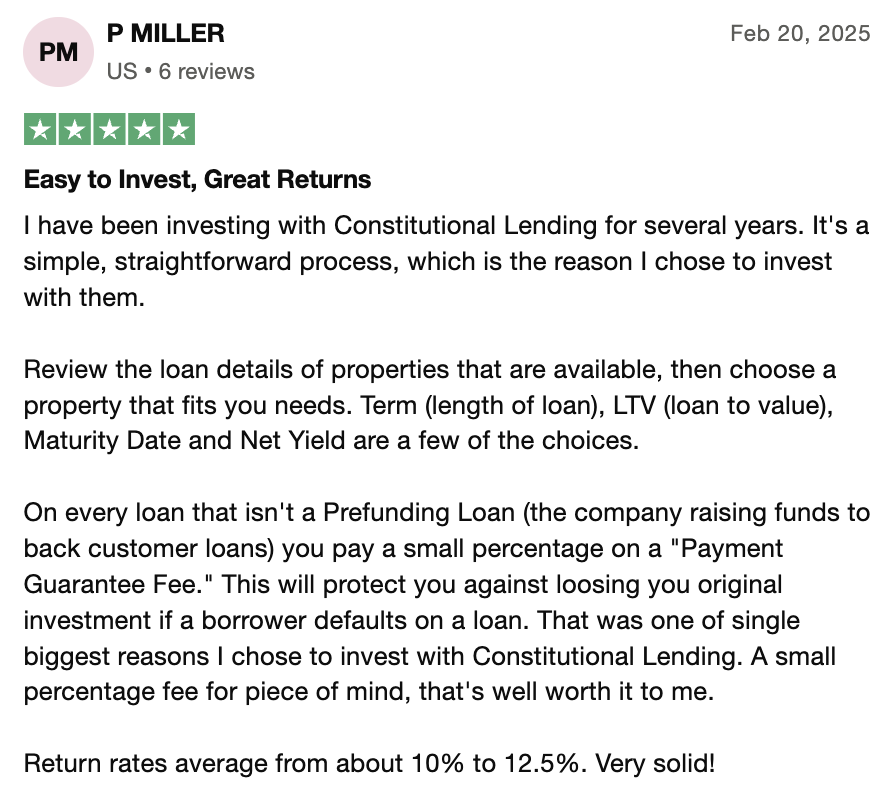
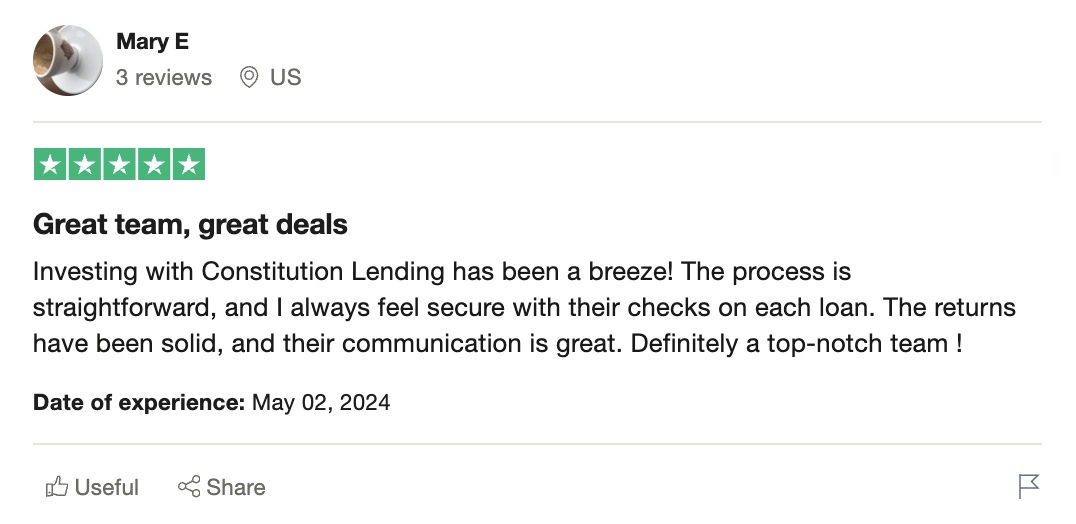
Here’s what investors say about Constitution Lending’s hard money loans:

2. Money Market Accounts
Banks and credit unions offer money market accounts, or MMAs, as a close cousin to the high-yield savings account (HYSA). As a type of deposit account, they function similarly whether opened through online banks or a local branch.
FDIC-insured deposits at banks are protected up to $250,000 per depositor per institution, while credit union deposits carry equivalent protection through the National Credit Union Administration. Most accounts allow withdrawals at any time without penalties, and many come with check-writing privileges or a linked checking account for easier access.
The core limitation is returns. Money market accounts offer no meaningful yield advantage over a high-yield savings account because both products track the federal funds rate directly. When the Fed cuts rates, money market yields fall in lockstep. Switching from a HYSA to a money market account does not solve the yield problem.
Liquidity is where money market accounts genuinely stand out. Most allow withdrawals at any time without penalties, and the check-writing and debit card features make them one of the most flexible options on this list.
The main access barrier is the minimum balance requirement. Many money market accounts require $1,000 to $10,000 to earn the advertised rate, which can be a hurdle for smaller investors.
Verdict: A money market account is a safe, liquid option but does not move the needle on yield. If your goal is to earn meaningfully more than 4%, a money market account will not get you there.
3. Certificates of Deposit
Banks and credit unions offer certificates of deposit, or CDs, as time deposits that pay a fixed interest rate in exchange for locking your money up for a set period, typically ranging from 3 months to 5 years. Most 12-month CDs currently pay between 4% and 4.5% APY, with longer terms offering slightly higher rates in some cases.
Returns are marginally better than HYSAs in some cases, but the difference is modest. The more significant issue is that the rate locks in at the time of purchase. If rates rise after you commit, you earn less than the market rate until the term ends, with no way to adjust.
Some investors manage this by building a CD ladder, splitting their capital across CDs with staggered terms so a portion matures regularly and can be reinvested at whatever rate is currently available.
Liquidity is the weakest point on this list. Withdrawing before the term ends typically triggers an early withdrawal penalty, often equivalent to several months of interest. If you need access to your capital unexpectedly, a CD can leave you worse off than a HYSA.
Most CDs require a minimum deposit of $500 to $1,000 to open. Jumbo CDs, which offer higher rates, typically require $100,000 or more. FDIC insurance covers up to $250,000 per depositor per institution, so principal protection is strong within those limits.
Verdict: CDs offer slightly better rates than HYSAs in some cases but sacrifice liquidity to get there. If you need flexibility, a CD is not the right fit. If you are comfortable locking your money up for 12 months or more, they are worth considering alongside real estate debt.
4. Treasury Bills
The U.S. government issues Treasury bills, or T-bills, as short-term debt instruments with maturities ranging from 4 weeks to 52 weeks. Most major brokerages and TreasuryDirect allow investors to buy and sell T-bills directly, with current yields sitting between 4% and 4.5% depending on the term.
Returns are comparable to HYSAs, with one meaningful advantage: the federal government does not subject T-bill interest to state and local income taxes. Depending on where you live, that tax treatment can improve your after-tax yield relative to a savings account.
Liquidity is strong. Investors can buy and sell T-bills on the secondary market at any time, and the short maturities mean capital is never locked up for long.
The U.S. government backs T-bills with its full faith and credit, making them virtually risk-free from a default standpoint. Investors can purchase them in increments as small as $100 through TreasuryDirect.
Verdict: T-bills suit safety-conscious investors well, offering government-backed protection and slightly better after-tax returns than a HYSA. The trade-off is that yields track the federal funds rate and will fall as the Fed cuts. They do not close the yield gap the way real estate debt does.
5. Dividend Stocks
Dividend stocks give you a way to earn regular income from equity ownership, since these are shares in public companies that pay out a portion of their earnings to shareholders on a regular basis.
Established companies in sectors like utilities, consumer staples, and financials typically pay between 3% and 6% annually, though some higher-yield options carry more risk. Investors who prefer a diversified approach can also access dividend-focused mutual funds rather than picking individual stocks.
Returns can match or exceed HYSA rates, but stock price performance determines total returns. A stock paying a 5% dividend yield that drops 10% in value has effectively cost you money. The dividend income is predictable, but the overall return is not.
Liquidity is one of the strongest points for dividend stocks. Investors can buy and sell them during market hours through any brokerage account with no penalties or lockup periods.
Capital protection is the main weakness. Market conditions, company performance, and broader economic factors all drive stock prices up and down. A market downturn can erode the value of your holdings significantly, regardless of the dividend yield, leaving your principal exposed in a way that a HYSA or real estate debt does not.
Most brokerages offer fractional shares, so investors can get started at virtually any capital level within their regular investment accounts.
Verdict: Dividend stocks offer good liquidity and potentially competitive yields, but market volatility puts your principal at risk in a way that HYSAs and real estate debt do not. They suit investors with longer time horizons who can tolerate price fluctuations better than those looking for a stable HYSA replacement.
6. REITs
Real estate investment trusts, or REITs, own and operate income-producing real estate and must distribute at least 90% of their taxable income to shareholders as dividends. Investors can buy and sell publicly traded REITs on major stock exchanges like any other stock.
Returns are strong historically, but that figure combines dividend income with price appreciation. The income component alone typically yields between 3% and 6% annually depending on the REIT type and market conditions, which is not dramatically better than a HYSA on a cash basis.
Publicly traded REITs offer strong liquidity, with investors able to buy and sell during market hours through any brokerage account. Non-traded REITs operate differently, often carrying lockup periods of several years with limited exit options.
Capital protection is the main limitation. Stock market volatility drives REIT prices, and values can decline significantly during real estate downturns or broader market selloffs. Unlike real estate debt investors, REIT shareholders hold equity positions with no structural protection from losses in property values.
Investors can purchase publicly traded REITs for as little as the price of a single share, and most brokerages offer fractional shares. Non-traded REITs typically require minimums of $1,000 to $10,000.
Verdict: REITs offer strong historical returns and good liquidity, but equity market volatility puts principal at risk. For investors looking to replace a HYSA with something safer and more predictable, real estate debt offers stronger capital protection and more consistent monthly income.